SEO vs Paid Ads is the first real budget fight most Indian small businesses have. And it usually gets settled badly — by whoever pitched last, or by some blog built around American CPCs that have nothing to do with your market.
This guide settles SEO vs Paid Ads with arithmetic instead.
You’ll get real 2026 India cost benchmarks in rupees. A break-even formula you can run tonight on your own numbers. A twenty-minute screen test that tells you which keywords are worth chasing organically and which ones you should simply bid on. And a 90-day sequence that stops both channels from fighting over the same rupee.
1. SEO vs Paid Ads: What Your Money Actually Buys in Each Channel
cSpeed is a symptom. The real difference is accounting — one channel builds something you keep, the other rents something you have to keep re-renting. Until you see that written down, every comparison you read is just somebody’s opinion.
The Switch-Off Test
Here’s a diagnostic no agency will volunteer. Ask yourself: if I stopped all marketing spend today, how many of this month’s enquiries would still show up next month?
Call it your Residual Lead Rate.
- Paid ads: roughly 0–5%. Pause the budget and impressions die the same afternoon. A thin trickle of brand searches survives. That’s about it.
- SEO: typically 85–95% for the next six to twelve months. Rankings decay, sure — but slowly, and your content keeps pulling organic traffic while you sleep.
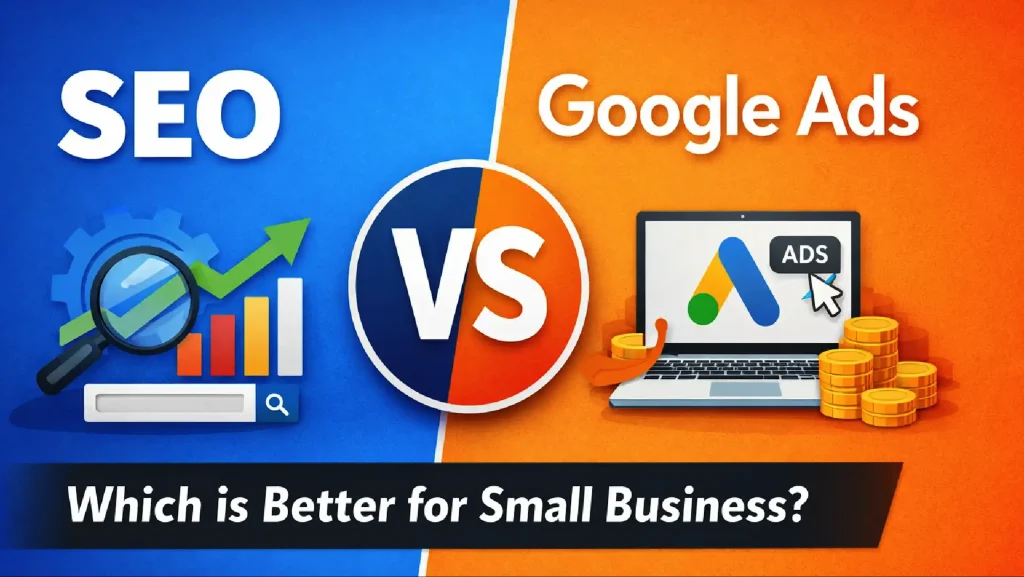
Why the Accounting Matters More Than the Timeline
A Google Ads campaign is a pure expense line. It resets to zero on the 1st of every month, every month, forever. Search engine optimisation behaves more like capital work on a shop you own — the money turns into ranking pages, internal links, reviews and topical authority that stay on your books.
- Ads buy attention now. SEO buys a distribution channel forever.
- You can’t sell an ad account with the business. A site pulling 8,000 sessions of organic traffic a month? That transfers.
- Ads hand you clean, same-week data. SEO hands you compounding, which looks painfully slow in month two and blindingly obvious in month twelve.
- Your return on investment from ads gets calculated monthly, then wiped. Your return on investment from SEO is cumulative and never resets.
Which is why comparing the two on one month of spend is meaningless. You’re holding a rent receipt next to a construction bill. Judge SEO vs Paid Ads over eighteen months, or don’t judge them at all.
Table 1: SEO vs Paid Ads — Where Every ₹1,000 Actually Goes
| What you are buying | SEO (₹1,000) | Paid Ads (₹1,000) |
|---|---|---|
| Asset created | Ranking page, links, authority | None — spend is consumed |
| Value in month 12 | Still working | ₹0 |
| Residual Lead Rate | 85–95% | 0–5% |
| Resale value | Transfers with the business | Non-transferable |
| Speed to first click | 60–120 days | Same day |
| Cost direction over time | Falls per lead | Rises with competition |
2. SEO vs Paid Ads Cost Comparison: Real 2026 Numbers for India
SEO vs Paid Ads comparisons written for Western markets are actively misleading here. Indian CPCs run roughly 70–85% below US averages. So when an American article warns you that “ads are too expensive for small businesses,” it’s describing a market where a single legal click costs more than your entire daily budget.
Different market. Different maths. Different answer.
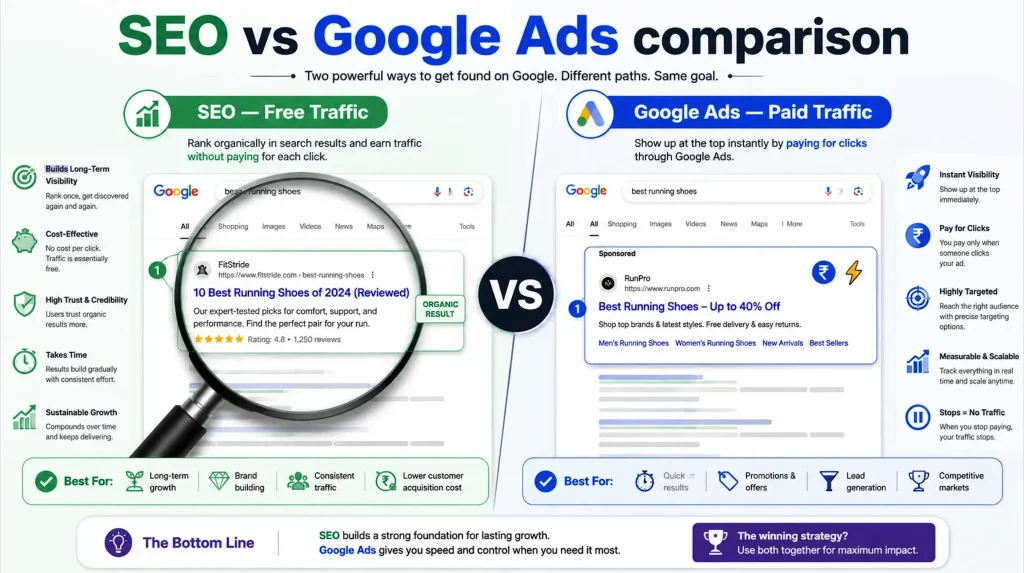
What a Click Costs in India
Average Google Ads search CPCs by sector, with typical cost per lead alongside:
- Real estate: ₹65 CPC · ₹800–2,000 per lead
- Finance & insurance: ₹45 CPC · ₹500–1,500 per lead
- Legal services: ₹38 CPC
- Education & EdTech: ₹28 CPC · ₹400–1,000 per lead
- Healthcare: ₹22 CPC · ₹300–700 per lead
- SaaS / B2B tech: ₹20 CPC · ₹600–1,800 per lead
- Home services: ₹12 CPC · Ecommerce: ₹10 CPC
Indian search CTR usually lands between 4.5% and 7%, so ₹30,000 a month in home services buys you somewhere around 2,500 clicks.
What SEO Costs in India
- Local SEO (5–10 keywords, Google Business Profile): ₹8,000–20,000/month
- Growth-stage SMB (20–50 keywords, 4–8 content pieces): ₹25,000–75,000/month
- Mid-market topic-cluster programmes: ₹80,000–1,50,000/month
- The bits nobody quotes: ₹2,500–8,000 per 1,000-word article, ₹3,000–25,000 per placed link, plus ₹1.2–2.4 lakh a year in tools if you run it in-house
The Cost Nobody Puts in the Proposal
Both sides hide things. Add these before you compare anything:
- Ads: management fee of 10–20% of spend, landing page builds, creative refreshes every six to eight weeks
- SEO: technical fixes, ongoing content marketing production, and the hours your team burns reviewing drafts
Honest read? At Indian prices both channels are affordable for most small businesses, which is exactly why price is the wrong thing to decide on. Cost per click tells you what traffic costs today. It tells you nothing about month eighteen. Choose on payback instead — and payback is what the next section calculates.
Table 2: SEO vs Paid Ads — 2026 Cost Benchmarks in India (INR)
| Sector | Avg CPC | Cost per lead (ads) | Realistic SEO retainer | Months to comparable volume |
|---|---|---|---|---|
| Real estate | ₹65 | ₹800–2,000 | ₹40,000–80,000 | 9–14 |
| Education | ₹28 | ₹400–1,000 | ₹25,000–60,000 | 7–12 |
| Healthcare / clinics | ₹22 | ₹300–700 | ₹15,000–35,000 | 6–10 |
| B2B / SaaS | ₹20 | ₹600–1,800 | ₹35,000–75,000 | 8–14 |
| Home services | ₹12 | ₹250–600 | ₹12,000–30,000 | 5–9 |
| Ecommerce | ₹10 | Varies by AOV | ₹25,000–70,000 | 8–15 |
3. SEO vs Paid Ads Break-Even: The Crossover Month Formula
SEO vs Paid Ads stops being a debate the moment you work out your crossover month — the month where every organic click you’ve ever paid for becomes cheaper than buying that same click from Google.
Almost nobody writing on this topic hands you the formula. Which is strange, because it fits on one line.
The Formula
Cumulative cost per organic click = Total SEO spend to date ÷ Total organic clicks to date
Crossover happens the month that figure drops below your industry’s cost per click.
That’s it. Two numbers you already have, one from the table above.
A Worked Example You Can Copy
Take a Pune home-services business paying a ₹25,000 monthly SEO retainer, in a sector where paid clicks go for ₹12.
- Clicks trickle in at first — basically nothing for two months, then a steady ramp as pages mature
- Cumulative cost per click starts absurdly high and drops every single month
- Around month 10 it slips under ₹12. And it never climbs back
- By month 18, ₹4.5 lakh of SEO has delivered traffic worth roughly ₹10.9 lakh at market rates
How to Read the Result
- Crossover before month 9? SEO is your primary channel. Fund it properly and stop second-guessing it.
- Crossover after month 15? Either your CPCs are unusually low or your content velocity is too slow. Let ads lead while you fix the second one.
- No crossover in sight by month 12? Something is broken. Thin content, wrong keyword research, or a website that simply cannot rank. Audit it before you spend another rupee.
The whole point of the crossover month is that it turns a philosophical argument into a date on a calendar. And dates are something a business owner can actually plan around.
Table 3: SEO vs Paid Ads — 18-Month Crossover Model at ₹25,000/Month
| Month | Cumulative SEO spend | Organic clicks (cumulative) | Cumulative cost per click | Same traffic bought at ₹12 CPC |
|---|---|---|---|---|
| 3 | ₹75,000 | 550 | ₹136 | ₹6,600 |
| 6 | ₹1,50,000 | 5,250 | ₹28.60 | ₹63,000 |
| 9 | ₹2,25,000 | 17,550 | ₹12.80 | ₹2,10,600 |
| 10 | ₹2,50,000 | 23,350 | ₹10.70 — crossover | ₹2,80,200 |
| 12 | ₹3,00,000 | 37,050 | ₹8.10 | ₹4,44,600 |
| 18 | ₹4,50,000 | 90,750 | ₹4.96 | ₹10,89,000 |
Modelled on typical ramp curves, not a guarantee. Run it with your own numbers.
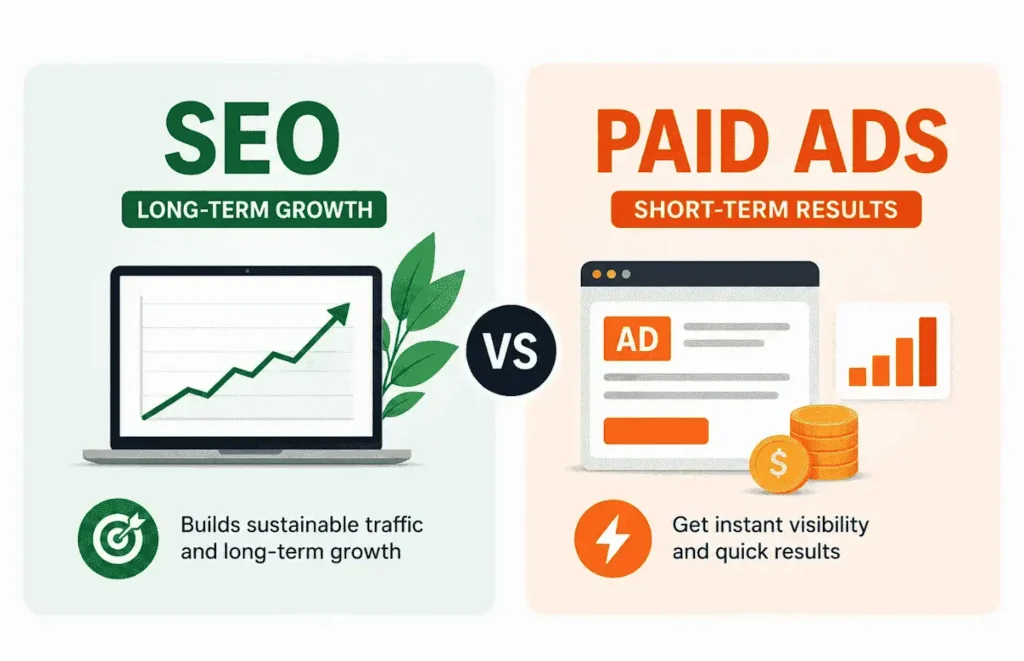
4. SEO vs Paid Ads in the AI Overview Era: The 2026 Shift Nobody Explains
SEO vs Paid Ads articles still ranking today were mostly written before AI answers took over the top of the results page. Which makes their advice about as useful as a 2019 road map of Bengaluru.
Here’s what changed. In the first four months of 2026, 68% of Google searches in the US ended without a single click — up from 60.45% in 2024. Biggest shift to this question in a decade, and it cuts in a direction most people get backwards.
The Two Big Datasets Disagree — and That’s the Insight
- SparkToro’s clickstream study found click-through rates fall by nearly 60% when an AI Overview shows up
- FirstPageSage’s position-level data found the opposite for organic: position one still pulls 38.9% CTR with an AI Overview present. It’s the ad clicks that collapse
- Both are right. The difference is query type. Informational searches get swallowed by the AI answer. Transactional and local ones mostly don’t
So the real question in SEO vs Paid Ads isn’t “is SEO dead.” It’s what percentage of your keyword list is informational. That mix decides your risk, not the headline stat, and thirty minutes of keyword research will tell you.
The Above-the-Fold Ad Density Test
Do this yourself. Mid-range Android phone, mobile data, twenty minutes:
- Search your ten highest-value keywords
- Screenshot the very first screen — no scrolling, no cheating
- Eyeball what share of that screen is ads and AI answers versus organic listings
- Score each keyword
If organic takes up less than 15% of screen one, that’s a paid keyword. Doesn’t matter what your agency’s proposal says.
One more thing worth knowing. AI answers cite sources. Ads never get cited. In 2026, being the source quoted inside an AI Overview is a form of visibility with no paid equivalent at all.
Table 4: SEO vs Paid Ads — SERP Diagnosis Chart for Your Top Keywords
| What screen one looks like | Organic share of screen | Verdict | Action |
|---|---|---|---|
| 4 ads + AI Overview | Under 10% | Paid keyword | Bid; skip content |
| AI Overview + Map Pack | 10–20% | Local play | Google Business Profile first |
| 2 ads + organic listings | 30–50% | Mixed | Run both, measure assists |
| Organic only | 60%+ | SEO keyword | Build content marketing depth |
| AI Overview citing blogs | Varies | Citation play | Write to be quoted, not clicked |
5. SEO vs Paid Ads by Business Model: Local, Ecommerce and B2B
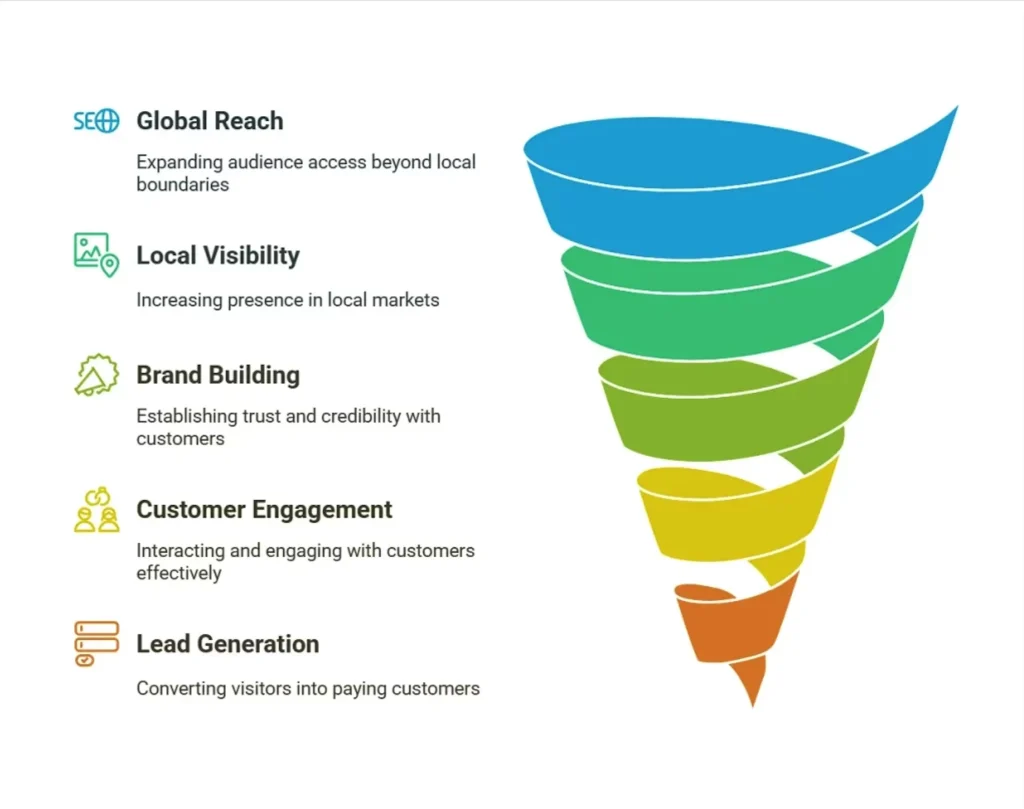
SEO vs Paid Ads has no universal winner, because the two channels behave completely differently depending on how your business actually makes money. A dental clinic, a D2C label and a chartered accountancy firm are three different economies wearing the same “small business” label.
Here’s how the answer splits — plus the one calculation that overrules everything else.
Local Service Businesses
For clinics, salons, plumbers, coaching centres and repair shops, the question usually gets framed wrong. Your fight isn’t website versus search ads. It’s Map Pack versus Local Services Ads.
- Google Business Profile is the highest-return asset you own, and it costs nothing
- Reviews, categories, photos and service areas move rankings faster than blogging ever will
- Use paid only to cover the hours or pin codes where you don’t rank yet
Ecommerce and D2C
- Shopping ads win on speed. Product and category page optimisation wins on margin
- Your average order value, not your industry, decides whether ads are viable at all
B2B and Professional Services
- Long sales cycles reward content marketing and search engine ranking depth, because buyers research for weeks before they ever enquire
- Ads work on bottom-funnel, high-intent terms only. Never on broad research queries, where you’re paying for clicks from people who won’t buy for a year
- Case studies and comparison pages drive better lead generation than any display campaign will
The Margin Gate — The Calculation That Overrules Everything
Maximum viable CPC = (Gross profit per sale × Landing page conversion rate) ÷ Target payback multiple
An education business earning ₹8,000 gross profit per enrolment at 2% conversion, targeting 3× payback, can afford ₹53 a click. Sector CPC is ₹28. Ads work, comfortably.
Now take a store making ₹300 an order at 1.5% conversion. It can afford ₹1.50 — against a ₹10 ecommerce CPC. Those ads cannot work at any level of optimisation until the margin changes. No bid strategy on earth fixes that.
Table 5: SEO vs Paid Ads — Channel Fit Scorecard by Business Model
| Business model | Best first channel | Ads role | SEO role | Watch-out |
|---|---|---|---|---|
| Local services | Google Business Profile | Fill coverage gaps | Service + area pages | Review velocity |
| Clinics / healthcare | Local SEO | Branded + urgent terms | Condition guides | Ad policy limits |
| Ecommerce / D2C | Depends on AOV | Shopping + retargeting | Category pages | Margin gate |
| B2B / SaaS | SEO | Bottom-funnel only | Comparison content | Long lag to revenue |
| Professional services | SEO | Emergency terms | Authority content | Trust signals |
| Coaching / EdTech | Paid first | Admission season | Evergreen guides | Seasonality |
6. SEO vs Paid Ads Together : The 90-Day Sequencing Playbook
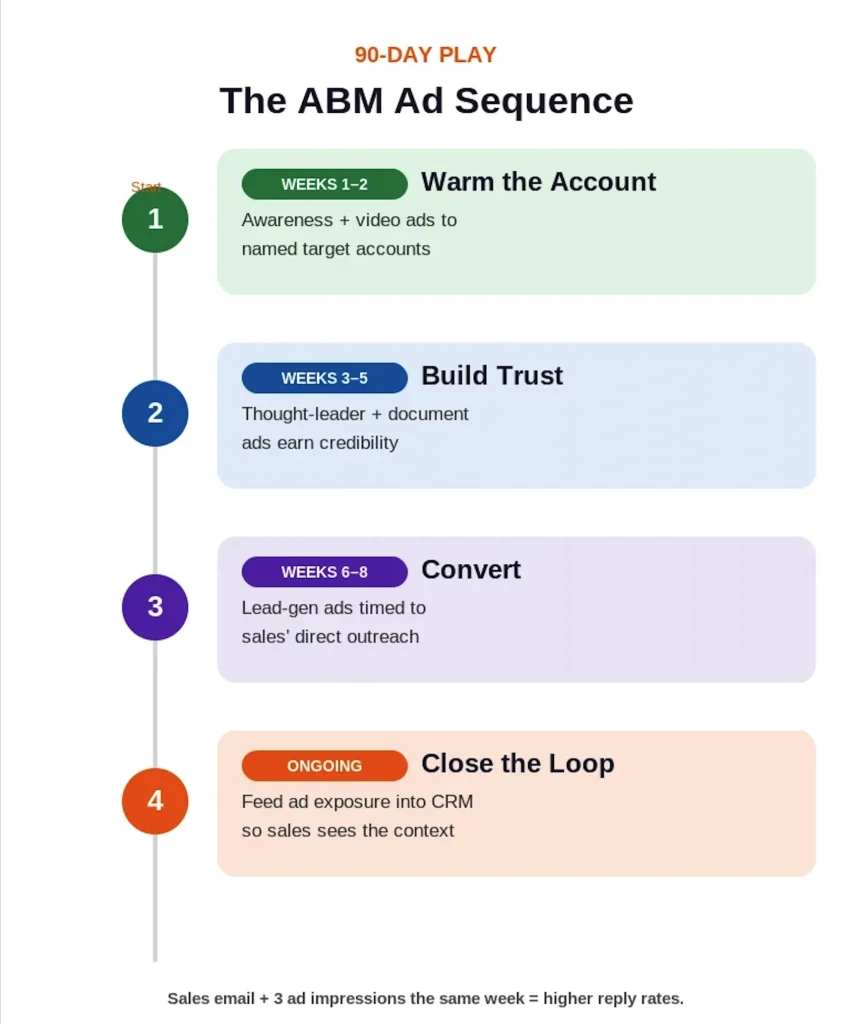
SEO vs Paid Ads is the wrong preposition. Sequenced properly, ads make SEO cheaper and SEO makes ads cheaper, and the businesses that grow fastest treat them as one system running at two speeds.
Here’s the ninety-day sequence that works for most Indian small businesses starting cold.
Days 1–30: Buy Your Keyword Research
Run a tight, deliberately small Google Ads campaign. ₹25,000–40,000 is plenty. Its job is not return on investment. Its job is to produce one thing — a converting search terms report.
- Exact match and phrase match only. Kill broad match on day one
- Track calls and form fills separately
- Export every single search term that produced a real enquiry
This is the cheapest keyword research money can buy. No tool on earth tells you which queries convert. Only your own money does that.
Days 31–60: Build on Proven Demand
- Write pages for the twenty search terms that converted, not the two thousand which has tool suggested.
- Fix the technical basics, internal links, page speed & Content
- Fill out Google Business Profile completely if you serve a local area Must !
Days 61–90: Split and Defend
- Move budget toward terms where organic traffic is realistic. Keep your Google Ads campaign running on the ad-dominated screens
- Check your Assist Ratio: what share of paid conversions had an earlier organic session? Last-click reporting badly under-credits SEO, and acting on it means defunding the channel that’s quietly doing the work
- Apply the concentration rule: never let one channel exceed 70% of your lead generation. Core updates happen. Ad account suspensions happen. Single-channel businesses rarely survive either
Why the Sequence Beats Either Channel Alone
Run it backwards and it falls apart. Building content marketing first means guessing at demand for six months. Running ads forever means paying full retail for every click until the day you close. Sequencing SEO vs Paid Ads in this order is what makes your blended cost per lead fall quarter after quarter instead of drifting up.
Table 6: SEO vs Paid Ads — 90-Day Budget Split and Milestones
| Phase | Ads share | SEO share | Primary goal | Milestone |
|---|---|---|---|---|
| Days 1–30 | 80% | 20% | Discover converting terms | 20+ proven queries |
| Days 31–60 | 55% | 45% | Publish on proven demand | 8–12 pages live |
| Days 61–90 | 40% | 60% | Reduce blended cost per lead | First page-one rankings |
| Months 4–6 | 35% | 65% | Compound organic traffic | Crossover in sight |
| Months 7–12 | 25% | 75% | Defend and expand | Under 70% single-channel |
Frequently Asked Questions
1. Is SEO or paid advertising better for a brand-new small business with no website traffic?
For a business with no history, SEO vs Paid Ads resolves in favour of a small paid campaign — but treat it as research, not growth. Thirty days of exact-match ads will tell you which queries actually produce enquiries, and no keyword tool can give you that. Build your content marketing plan on those proven terms from day 31. Spending six months chasing search engine ranking before you know what converts is the most common and most expensive mistake new businesses make.
2. How long does SEO really take to work in India?
Timelines are why SEO vs Paid Ads feels like an unfair fight in month one. For a local business with a clean website, you’ll usually see movement at 60–90 days and useful lead volume somewhere between five and nine months. Competitive national or ecommerce terms take eight to fifteen. Anyone promising page one in thirty days is either bidding on your own brand name or targeting keywords nobody searches.
3. Can I run SEO and Google Ads at the same time on a small budget?
Yes, and you should — SEO vs Paid Ads is rarely an either-or decision at small budgets. Below roughly ₹40,000 a month, split it 60:40 in favour of whichever channel your SERP diagnosis favours, then revisit every quarter. Running both also lets you measure your Assist Ratio, which usually reveals that SEO is contributing more lead generation than your dashboard admits.
4. Have AI Overviews made SEO pointless for small businesses?
No, but they’ve changed the target, which is why the SEO vs Paid Ads answer looks different in 2026 than it did in 2023. Informational queries lose clicks. Transactional and local queries largely hold up. Being cited inside an AI answer is now a real form of visibility, and there’s no paid equivalent for it. The practical response is to shift content toward buying-intent and location-specific pages instead of generic “what is” articles.
5. What if my industry’s cost per click is too high to make ads profitable?
Run the Margin Gate calculation before you blame the platform — it’s the fastest way to settle SEO vs Paid Ads for your specific business. If your maximum viable CPC sits below your sector average, no amount of bid optimisation rescues the campaign. The problem is unit economics, not the ad account. Fix average order value, conversion rate or offer strength first, and let SEO carry demand while you do.
6. Which channel gives better return on investment over three years?
Across a three-year window, SEO vs Paid Ads resolves in favour of SEO in almost every modelled scenario, because cumulative cost per click falls as organic traffic compounds while ad costs climb with competition. But that only holds if content keeps shipping. An abandoned SEO programme loses search engine ranking within a year — at which point ads, however expensive, quietly become the better investment.
Conclusion
SEO vs Paid Ads isn’t a choice between two marketing channels. It’s a choice between renting demand and owning it, and most small businesses need both at different intensities. Run the Switch-Off Test to see what your spend actually leaves behind. Run the Margin Gate before funding a single click. Run the Ad Density Test before commissioning content. Then sequence them — let ads find the demand, let search engine optimisation own it permanently. Do it in that order and your blended cost per lead falls every quarter instead of climbing. That’s the whole answer. It’s arithmetic, not opinion.
Ready to run these numbers on your own business? Digitrise builds SEO and paid campaigns around the crossover month, not guesswork.
For more such research on content visit perplixity.ai