Content marketing analytics helps you understand how your content contributes to business growth. It tracks performance, audience engagement, conversions, and return on investment using real data. By analysing the right metrics, businesses can improve their content strategy, make informed decisions, and create content that attracts, engages, and converts the right audience.

What is Content Marketing Analytics? A Working Definition That Actually Holds Up
What is content marketing analytics? In plain terms, it is the practice of collecting, connecting and interpreting data about every asset your brand publishes, so that each blog post, landing page, newsletter and video can be judged on the business outcome it produced rather than the applause it received. Most teams confuse this with web reporting. Web reporting tells you that a page received 4,000 sessions last month. Content marketing analytics tells you that the page attracted 4,000 sessions, that 62% of them arrived from non-branded search, that 180 of those visitors subscribed to your newsletter, and that the newsletter later produced eleven qualified enquiries.
The three layers every serious setup includes
- Behavioural layer — sessions, scroll depth, engaged time, returning readers, and other website statistics
- Acquisition layer — where readers came from: organic search, referral, social, email marketing, or Google Ads
- Outcome layer — subscriptions, demo requests, sales-qualified leads, revenue, and retention
What is Content Marketing Analytics Measuring? The Metric Hierarchy That Prevents Vanity Reporting
What is content marketing analytics measuring when it is done properly? It measures a chain, not a collection. Every meaningful content programme moves a reader through four states — discovery, engagement, conversion and retention — and each state has metrics that genuinely belong to it. Problems begin when teams pull metrics from all four states, sort them alphabetically, and present them as a report. A page with high impressions and low engaged time is not “performing well with room to improve.” It is failing at the second step of the chain, and no amount of extra promotion will fix a copy problem. This is where a metric hierarchy earns its keep: it forces you to diagnose in sequence.
Diagnose in this order, not in parallel
- Discovery — impressions, non-branded keyword coverage, referring domains
- Engagement — engaged sessions, average engagement time, scroll completion, return visits
- Conversion — subscription rate, lead form completions, assisted conversions
- Retention — repeat readership, email list churn, customer lifetime value by first-touch content
What is Content Marketing Analytics Without a Connected Tool Stack? Mostly Guesswork
What is content marketing analytics built on? Four data sources that most organisations already own but rarely connect. The first is Google Analytics, which gives you behavioural data — who arrived, what they read, how long they stayed and what they did next. The second is Search Console, which is the only place you will see impressions and query-level data for organic discovery. The third is your email platform, because email marketing is where content converts anonymous readers into known contacts, and open and click data reveals topic preference with unusual precision. The fourth is your CRM or sales system, which holds the outcomes everyone actually cares about. Individually, each tool tells a partial story.
Google Analytics knows a visitor read three articles but not that they later signed a contract. Your CRM knows the contract value but not which article started the relationship. The entire craft lies in joining those records, usually through consistent UTM tagging, a persistent identifier captured at form submission, and a shared naming convention that survives staff turnover.
Configuration essentials most teams skip
- Define conversion events in Google Analytics before you need them, not after
- Enforce one UTM naming convention across email marketing, social and Google Ads
- Exclude internal and agency traffic so website statistics reflect real readers
Signals your stack is genuinely connected
- You can name the first article a closed customer ever read
- You can compare organic and paid performance for the same asset
- Your email platform and analytics agree on subscriber numbers within a few percent
| Content Marketing Analytics Tool Stack | Primary Job | Question It Answers Alone | Question It Answers Only When Connected |
|---|---|---|---|
| Google Analytics | Behaviour and outcome tracking | What did visitors do on site? | Which content path precedes revenue? |
| Google Search Console | Organic discovery | Which queries show our pages? | Which queries produce customers? |
| Email marketing platform | Nurture and retention | Who opened and clicked? | Which topics predict purchase intent? |
| Google Ads | Paid amplification | What did clicks cost? | Which organic assets deserve paid support? |
| CRM | Revenue record | What closed? | Which content influenced the deal? |
What is Content Marketing Analytics Telling You About SEO and Website Statistics?

What is content marketing analytics revealing about your search performance that a rank tracker cannot? Context. A rank tracker reports that you moved from position eight to position five for a target term. Useful, but incomplete. Content analytics tells you whether that movement changed anything: did impressions rise proportionally, did click-through improve, did the additional visitors behave like the visitors you want, and did any of them convert? We regularly see pages climb the results page while producing fewer leads, which usually signals that the page has started ranking for a broader and less commercial query set. that what is content marketing analytics ?
Segment before you rewrite
- Low impressions → topical authority gap; build supporting content and internal links
- High impressions, low clicks → title and meta description need work
- High clicks, low engagement → the page does not deliver what the title promised
Website statistics worth reviewing monthly
- Percentage of total organic traffic coming from non-branded queries
- Number of pages earning at least one visit per week (“active page count”)
- Share of conversions assisted by content published more than a year ago
Is Content Marketing Analytics Doing Across Email Marketing and Google Ads?
Is content marketing analytics for, if your content lives across three or four channels at once? Attribution — deciding, honestly, how credit should be shared between the touchpoints that led to a result. This is where most reporting quietly breaks. A reader discovers a blog post through organic search, subscribes to your newsletter, returns twice through email marketing over the following month, sees a retargeting campaign through Google Ads, and finally books a call from a branded search.
Under default last-click reporting, branded search takes all the credit and the blog post that started everything takes none. Repeat that pattern across a quarter and you will systematically underfund the channel doing the most work. The fix is not a single perfect attribution model, because none exists. The fix is choosing a model deliberately, documenting why, and applying it consistently so that period-on-period comparisons stay valid.
Attribution decisions to make before your next report
- Choose one model and state it on every report you publish
- Set an attribution window long enough to cover your real sales cycle
- Track assisted conversions separately from last-click conversions
- Review the model twice a year rather than changing it mid-quarter
What is Content Marketing Analytics Reporting Supposed to Look Like? A Cadence That People Follow
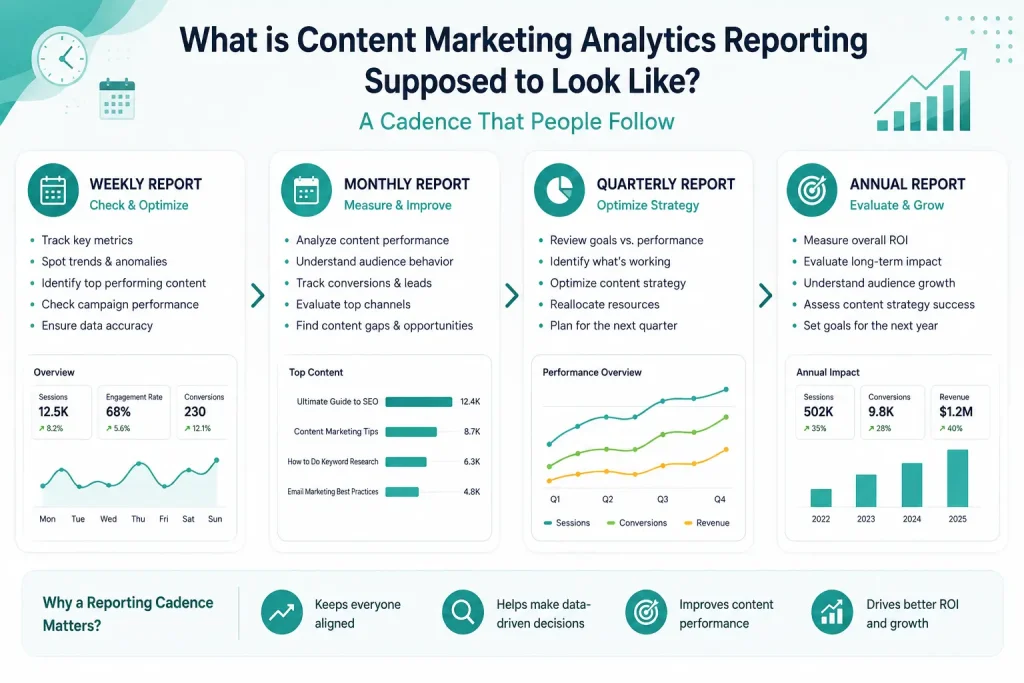
What is content marketing analytics worth if the report goes unread? Nothing at all, which is why cadence deserves as much design attention as measurement. The failure pattern is familiar: a thirty-slide monthly deck, assembled over two days, skimmed for ninety seconds, and forgotten. The remedy is to split reporting by rhythm rather than by audience. Weekly checks are operational — they exist to catch breakage, not to judge performance. Nobody should draw conclusions about a blog post from seven days of data, but everyone should know within seven days if tracking has broken, a page has been deindexed, or a form has stopped submitting.
Monthly reviews are tactical, focused on which content to refresh, promote or retire. Quarterly reviews are strategic, where topic clusters, channel mix and budget allocation are genuinely reconsidered. Annual reviews are archival: what did we learn, what will we stop doing, and what does our content actually earn per rupee invested? Separating these prevents the most common reporting sin, which is making strategic decisions on tactical data — cutting a topic cluster because one month dipped, or doubling a budget because a single post went unusually well. The cadence also protects the analyst’s time, since a weekly health check takes twenty minutes when it is scoped properly, while a weekly full report takes a day and delivers nothing extra.
Reporting habits worth adopting
- Annotate your Google Analytics timeline whenever you publish or launch a campaign
- Compare year-on-year as well as month-on-month for seasonal businesses
- Keep a decision log so you can review whether past calls were correct
| Content Marketing Analytics Reporting Cadence | Purpose | Core Focus | Audience |
|---|---|---|---|
| Weekly | Health check | Tracking errors, indexing, form failures | Content and technical team |
| Monthly | Tactical review | Refresh, promote or retire decisions | Marketing lead |
| Quarterly | Strategic review | Topic clusters, channel and budget mix | Leadership |
| Annual | Learning review | Content ROI and long-term patterns | Leadership and finance |
What is Content Marketing Analytics Missing From Most Competing Articles? The Gaps We Found
What is content marketing analytics coverage like elsewhere on the web? We read through the highest-ranking guides for this topic before writing, and the pattern is consistent: strong on definitions, adequate on tools, and almost silent on implementation. Nearly every competing article explains What is content marketing analytics. Very few explain what to do when two metrics contradict each other, which is the situation practitioners face weekly.
Three gaps stood out. First, almost nobody addresses measurement for small teams — the advice assumes a data analyst exists, which is untrue for most Indian SMEs and startups. Second, the treatment of content decay is superficial; articles mention that content ages but rarely explain how to distinguish a genuine decline from ordinary seasonality, which requires at least twelve months of comparison data and a check on query composition.
Gaps we found in competing coverage
- No guidance for teams without a dedicated analyst
- Content decay treated as inevitable rather than diagnosable
- Analytics kept separate from the editorial workflow
- Unsourced industry benchmarks repeated without verification
Conclusion
what is content marketing analytics ? Content marketing analytics is the key to understanding whether your content is actually delivering results. Instead of relying on guesses, it helps you measure performance, identify what works, improve what doesn’t, and make smarter marketing decisions. By setting clear goals, tracking the right metrics, and using tools like Google Analytics and your CRM together, you can turn data into meaningful business growth. In the end, successful content marketing is not about creating more content—it’s about creating content that delivers measurable value to people. By digitrise.in
Frequently Asked Questions
1. What is content marketing analytics in simple terms?
Ans. what is content marketing analytics ?It is the practice of measuring how your published content contributes to business results — not just how many people visited, but what those visitors did next and what it was worth. If web reporting counts your audience, content analytics values it.
2. Which tools do I need to get started?
Ans. Three are usually enough at the beginning: Google Analytics for behaviour, Google Search Console for organic discovery, and your email marketing platform for subscriber behaviour. Add CRM data once you can reliably link a form submission to a deal. Google Ads data becomes essential the moment you start promoting content with paid budget.
3. How is content marketing analytics different from web analytics?
Ans. Web analytics treats the website as the unit of measurement. Content marketing analytics treats the individual asset and topic cluster as the unit, and follows each one across its full lifespan — often eighteen months or more — rather than reporting on a fixed monthly window.
4. How long does it take to see meaningful results?
Ans. Expect roughly one month to fix tracking and agree definitions, three months before trends become readable, and six to twelve months before content ROI figures are trustworthy. Anyone promising conclusive data from four weeks of content performance is reading noise.
5. Can I measure email marketing and Google Ads in the same framework?
Ans. Yes, and you should. Consistent UTM tagging plus a documented attribution model lets you compare channels fairly. Without both, last-click reporting will over-credit branded search and under-credit the content that started the journey.
6. What is the most common mistake teams make?
Ans. Collecting data nobody uses. Before adding any metric to a report, ask which decision it would change. If there is no answer, leave it out — the shortest report that drives a decision beats the most comprehensive one that does not. Read more about what is content Marketing Analytics on wikipedia.